




GloryWatt integrates a signoff-grade power analysis engine that precisely calculates average and peak power for designs under specific application scenarios based on design netlists, standard cell libraries, parasitic parameters, and vector waveforms. GloryWatt effectively assists users in completing power verification, pinpointing power hotspots, and troubleshooting power anomalies. With broad multi-node support, GloryWatt comprehensively addresses power analysis requirements at advanced process nodes.
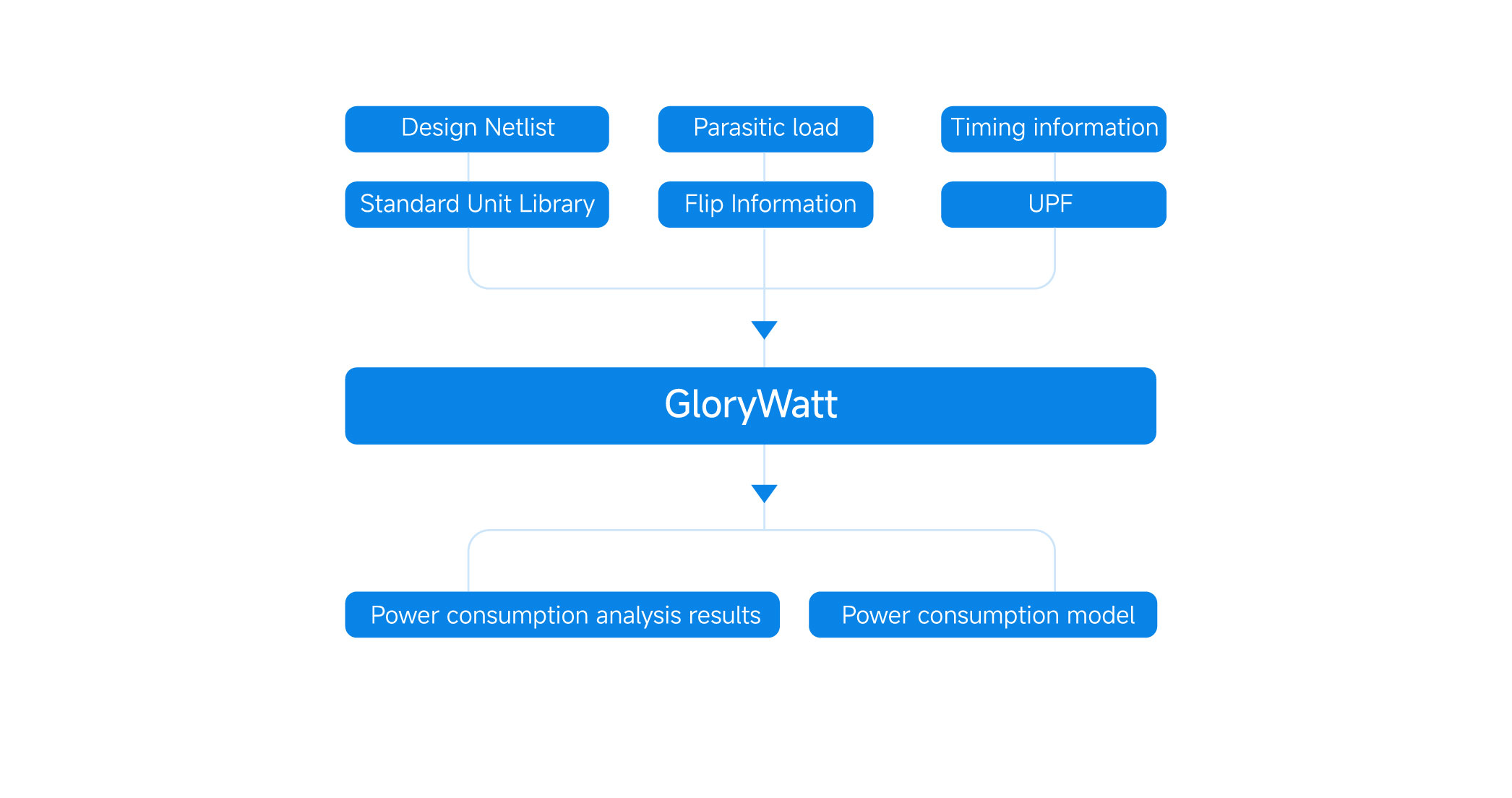
Format Compatibility & Flow Integration:
Fully supports standard backend design formats including DEF, Verilog, Liberty, SPEF, VCD, and SAIF for seamless integration with backend design flows.
Unique Power Modeling Technology:
Employs unique power modeling methodology that abstracts intermediate computation results into parametric models, supporting dynamic power recalculation based on temperature, voltage, and frequency—dramatically improving iteration and co-simulation efficiency.
Low-Power Design & Early Analysis:
Comprehensive low-power design flow support with wire load models for rapid post-synthesis power estimation. Built-in toggle rate propagation algorithm enables power estimation directly from RTL waveforms, significantly improving feedback efficiency during front-end design.
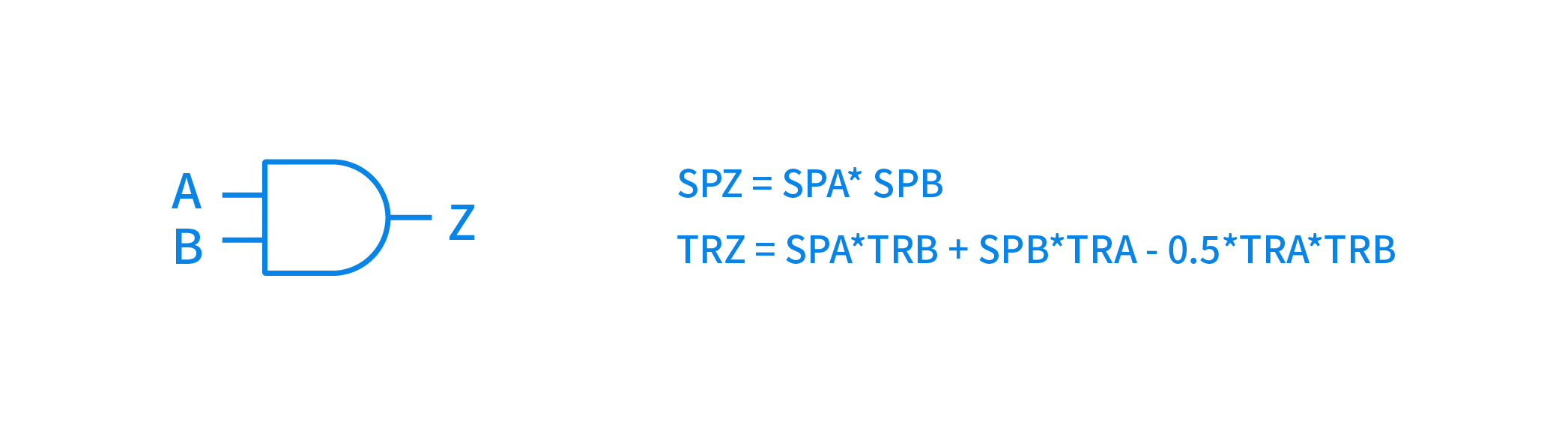
Toggle activity is a primary determinant of dynamic power. Accurate toggle information is typically obtained through simulation. The following table summarizes the key simulation methods and their differences:
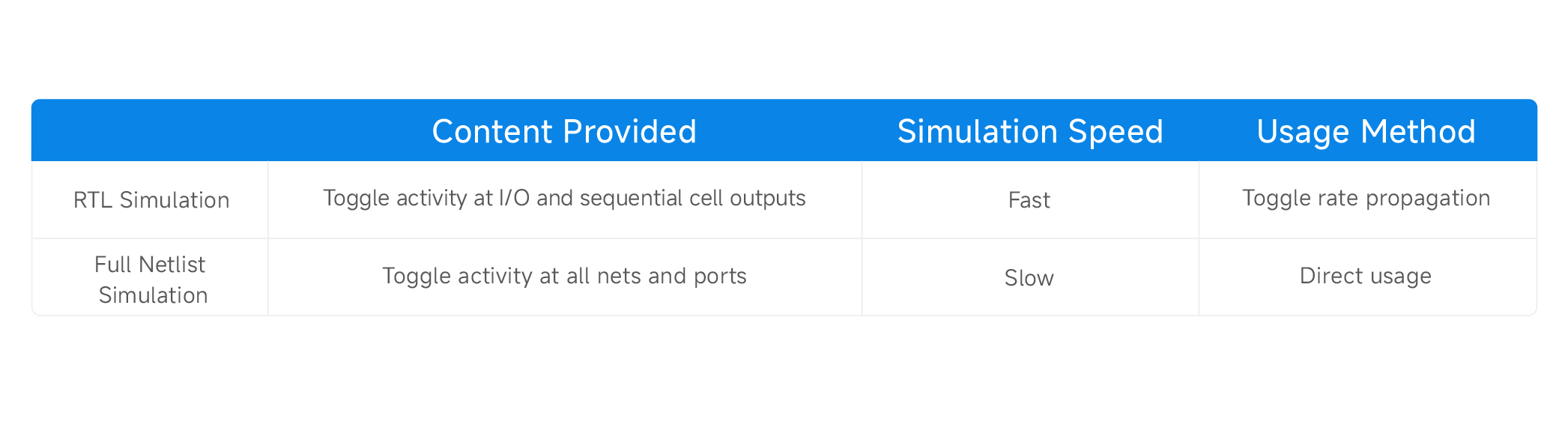
GloryWatt supports toggle rate propagation from RTL simulation results, significantly improving the efficiency of evaluating long-load average power. Compared to full netlist simulation results, the error is within 3%.



 Zhejiang public network security 33010802011331